Making Tires

We’re reimagining tire production by prioritizing renewable and recycled materials and efficient operations.

The Race to Reinvent the Tire

We are always exploring new approaches to sustainable tire manufacturing using renewable and recycled materials to develop products that deliver performance and promote sustainable value. It starts with sourcing renewable and recycled materials, then continues with efficient production that helps reduce energy and water usage at our facilities.

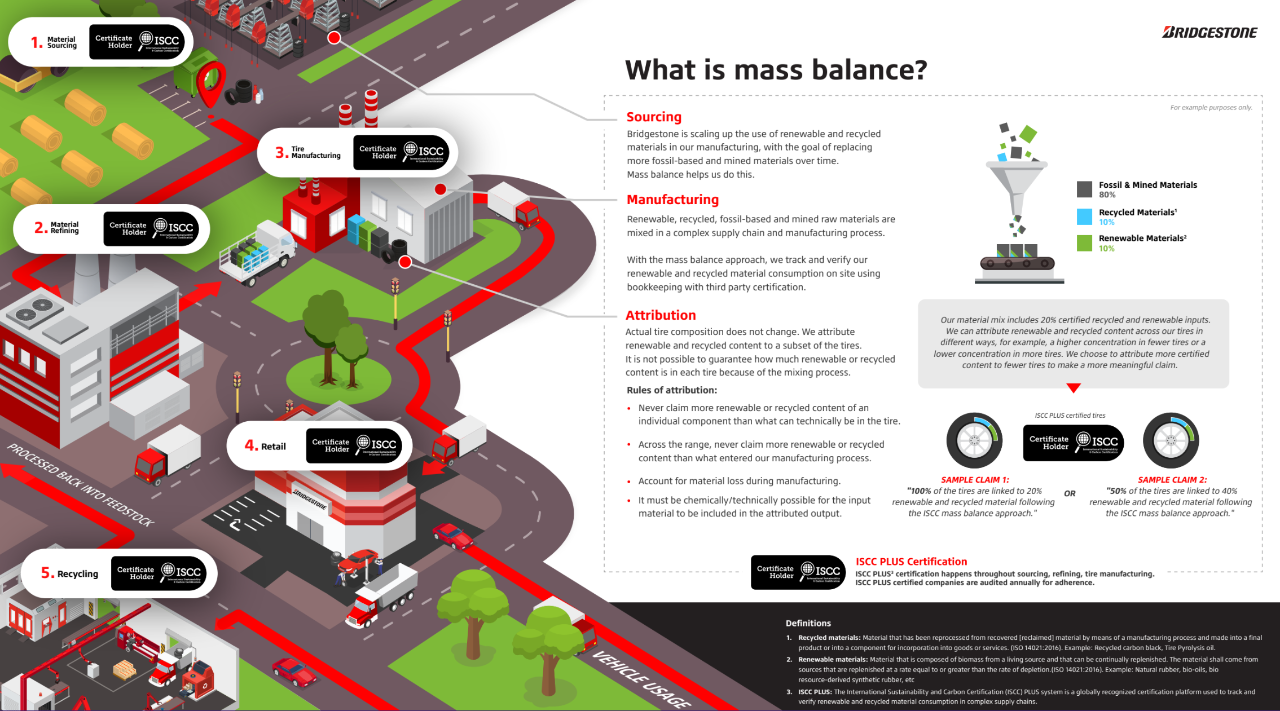
Click image to expand

Catalyzing Demand, Powering Change in Our Supply Chain

At Bridgestone, we're building a more sustainable future without waiting for perfect conditions. That’s why we use the mass balance approach with International Sustainability and Carbon Certification (ISCC) PLUS recognition, a trusted, third-party-certified method that allows us to scale up renewable and recycled materials today.

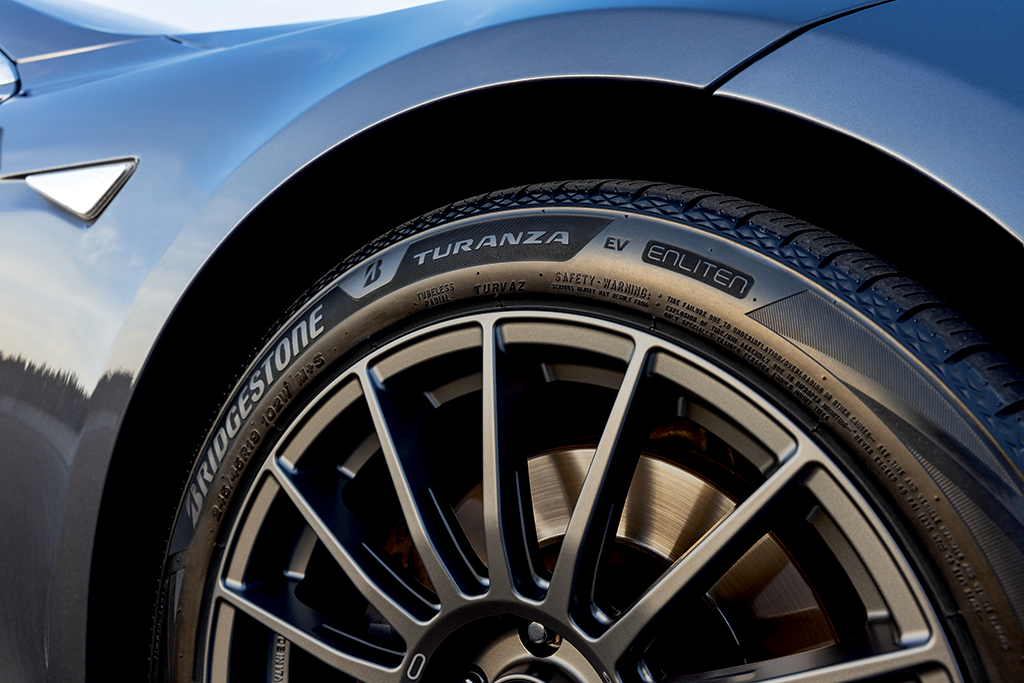
In April 2025, we debuted our first ISCC PLUS-certified commercial tire for waste collection fleets, the M870 demonstration tire, which supports the allocation of 70% recycled and renewable materials. We have tested alternative material in more than 70 projects to date, implementing only those that meet our performance standards. Our Turanza EV tire, for example, is available to drivers today.

In the race to reinvent the tire, mass balance isn’t the finish line—it’s the starting line. A tool that helps us scale circularity, strengthen trust and keep moving toward our long-term goals.

Driving the Search for a New Natural Rubber

Natural rubber is an essential material in almost all tires. It adds elasticity and tear resistance to tires and helps them withstand heat and pressure. Yet more than 90% of the world’s natural rubber comes from just one source: Hevea rubber trees in Southeast Asia.

Bridgestone is investing in sustainable innovation that seeks to diversify the world’s natural rubber supply and ultimately develop a natural rubber industry in North America.

In 2014, Bridgestone established its Biorubber Process Research Center in Mesa, Arizona, where our agronomists began cultivating and domesticating guayule, a resilient desert shrub native to Mexico and the Southwestern U.S. Supplied by guayule grown on our 281-acre farm in Eloy, Arizona, the center produced our first guayule natural rubber samples for tire testing in early 2015.

To prove the material in real world conditions, we took guayule from the lab to the track, debuting it in Firestone Firehawk race tires in 2022, and using it in every NTT INDYCAR SERIES® street course event during the 2023, 2024 and 2025 seasons. With guayule proving its power on the track, we’re exploring how to scale its use across the industry.

Bio-Oils on the Fast Track

Oils are used in tire production to enhance material workability and flexibility. By replacing petroleum-based oils with bio-oils, such as palm, soybean, pine tree and orange oils, we can help reduce dependence on petroleum products.

Over the last two years, we’ve tested and proven multiple ISCC PLUS-certified materials made from waste residue of palm oil in the race tires we produce for the Indianapolis 500. Our tests show that if these materials can perform under extreme conditions like motorsports—they can perform almost anywhere. 

Transforming Ethanol into Low-Carbon Butadiene

Most tires use a mix of natural rubber and synthetic rubber, because both offer unique performance advantages. A key compound in synthetic rubber is butadiene, which contributes to traction, rolling resistance and elasticity in tires, but also has a high carbon footprint.

Traditionally a petroleum byproduct, butadiene can also be made using ethanol, delivering a low-carbon alternative with identical performance qualities. As part of our efforts to understand and advance new, lower-carbon and renewable materials, Bridgestone is exploring how to obtain butadiene from ethanol (EtB) through internal projects and by canvasing the market for suppliers.

While this is a solution that will not be commercially available in this decade, it reflects Bridgestone’s forward-looking vision to support the future needs of our customers.

Are you an interested supplier?

Creating a Circular Tire Lifecycle with Recycled Carbon Black and Sustainable Carbon Black

Tires contain roughly 20% carbon black, an oil-derived material that helps enhance tire durability, strength and resistance to UV damage.

As we build a more circular lifecycle for tires, we’re incorporating recycled carbon black (rCB) into our products. Made from shredded scrap tires, rCB reduces our need for virgin carbon black. This helps cut waste, conserve resources and maintain high-performance. Between 2019 to 2024, we purchased approximately 11.9 million pounds of rCB and embedded it into about 31 million tires. 

The process to create rCB also creates an additional co-product, Tire Pyrolysis Oil (TPO). TPO can be used as a feedstock to produce carbon black, providing multiple, more sustainable avenues to create carbon black through the tire recycling process. 

Our Turanza EV tire, which is available today, features 20% renewable and an attribution of 30% recycled materials. Renewable materials include natural rubber and soybean oil, alongside ISCC PLUS certified circular carbon black and bio-circular synthetic rubber (styrene butadiene rubber and butadiene rubber) following the mass balance approach.1

1. A total of 30% of this tire is linked to ISCC-certified (circular and bio-circular) materials, which are sourced and allocated to the carbon black and synthetic rubber (styrene butadiene rubber and butadiene rubber) in this tire, following the ISCC mass balance approach. The ratio of bio-circular to circular materials may vary. Still, the total amount of ISCC-certified materials, equivalent to 30% of this tire, is guaranteed and allocated to each component accordingly. For more details about ISCC, please go to: https://iscc-system.org.

Built for Change: Our Manufacturing Facilities and Retail Facilities

We have retrofitted or built many of Bridgestone’s facilities to meet stringent Leadership in Energy and Environmental Design (LEED®) requirements. Additionally, we are able to reduce water consumption in our manufacturing processes through efficient use and recycling. 

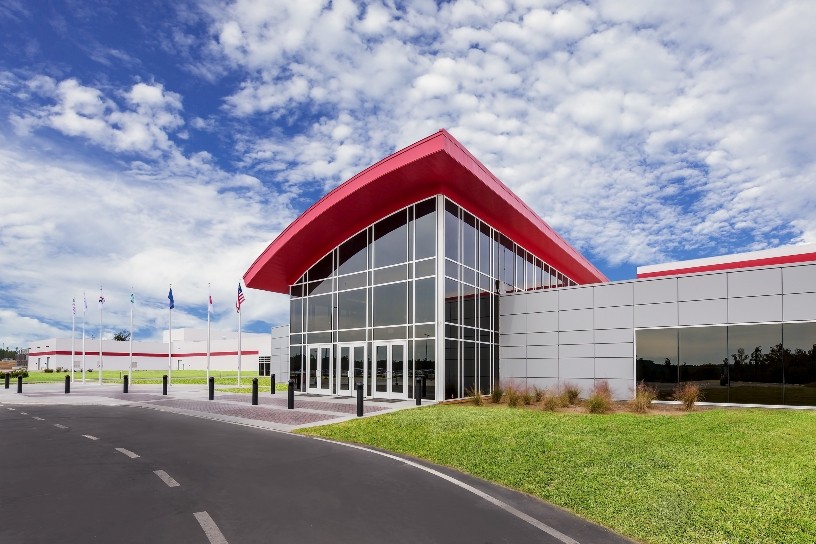
Americas Technology Center

For example, our innovations hub, the Americas Technology Center, received a LEED® Gold certification for its achievements in water management, energy savings and landscaping, among other categories.

Aiken plant

Similarly, our off-road tire plant in Aiken County, South Carolina, also meets LEED® standards. The facility features geomembrane pond liners and pavers that support water harvesting through retention ponds.


We continue accelerating our efforts toward more sustainable materials by actively pursuing ISCC PLUS certifications. We have more than 20 facilities (including tire and raw material plants) that meet ISCC standards and we are working to add more.


A History of Innovation

Learn about our mission, our achievements, and our ongoing commitments